


The Gambia Marks 75 Years of Multiparty Electoral Democracy
By Yunus S Saliu
As political parties and independent candidates prepare to contest the country’s forthcoming presidential election, The Gambia is marking 75 years of multiparty electoral democracy, a significant milestone in its political history.
The country held its first multiparty elections in November 1951, allowing Gambians to contest elections under different political party platforms for the first time, rather than solely as independent candidates.
Historian and author Hassoum Ceesay, Director General of the National Centre for Arts and Culture (NCAC), said the 1951 elections were the outcome of several constitutional developments that began with the introduction of a new constitution in 1947.
According to him, the 1947 constitutional reforms paved the way for Gambians to elect representatives to public office, with Edward Francis Small becoming the first Gambian elected to the Legislative Council, now known as the National Assembly.
However, the 1947 election was contested without political party affiliations, as the British colonial administration still restricted the formation of political associations.
The situation changed in 1951 when candidates began contesting elections under political party banners, marking the beginning of organised multiparty electoral competition in The Gambia.
Among those who contested were Edward Francis Small, representing the Gambia National League; Reverend J.C. Faye of the Democratic Party; and John Findi Dailley of the Common People’s Party. Other candidates, including Pierre Sarr Njie and Musa James Francis Semega, contested as independents.
DG Ceesay described the 1951 election as a defining moment in the country’s political development, noting that it was the first time Gambians had the opportunity to choose their representatives through a multiparty system.
Two candidates were elected to the Legislative Council: Reverend J.C. Faye of the Democratic Party and Garba Bala Jahumpa, who contested under the banner of the Gambia Congress Party. Although Jahumpa’s party had not yet been formally registered, it was officially registered in January 1952, becoming the country’s second registered political party.
A Remarkable Democratic Record
Reflecting on the country’s political journey since then, the Historian said The Gambia had participated in more than 20 multiparty elections over the past 75 years, describing the record as remarkable within the African context.
He said the country’s longstanding experience with multiparty elections was a democratic achievement that should be recognised and protected by all Gambians, irrespective of their political affiliations.
According to him, the country’s electoral history demonstrates a tradition of political participation and democratic competition that should serve as a source of national pride.
He emphasised that the achievement also places a responsibility on citizens and political actors to continue nurturing, protecting and strengthening the country’s democratic institutions and traditions.
Political Alliances Are Not New
Beyond the country’s record of multiparty elections, he noted that political alliances have also been a longstanding feature of Gambian politics, dating back to the 1950s.
He explained that political cooperation between parties first became evident during the 1955 Bathurst local government elections, when the United Party (UP) worked with the Gambia Muslim Congress in some wards to prevent the Democratic Party from securing electoral victories.
The practice continued in the 1960 general elections when the Gambia Muslim Congress and the Democratic Party formed an alliance known as the Democratic Congress Alliance (DCA). The coalition sought to present a united political front against the United Party, which was particularly influential in Bathurst under the leadership of Pierre Sarr Njie.
In the 1962 elections, the People’s Progressive Party (PPP) also entered into an alliance with the DCA in an effort to weaken the United Party’s electoral influence, particularly in its traditional stronghold of Bathurst.
During the 1970s, another significant political alliance emerged when the National Convention Party (NCP) joined forces with Pierre Sarr Njie’s United Party against the ruling PPP.
DG Ceesay said these historical developments demonstrated that political alliances were not a new phenomenon in The Gambia but had been an established feature of the country’s multiparty democratic experience.
He identified the 1962 DCA-PPP alliance and the 2016 opposition coalition as two particularly effective examples of political cooperation that resulted in major changes in the country’s political leadership.
The 2016 Coalition, which brought together several opposition parties and independent political actors, successfully ended Yahya Jammeh’s 22-year rule through the December 2016 presidential election.
Similarly, the 1962 alliance contributed to the electoral defeat of the United Party, demonstrating the influence that coordinated political efforts could have on electoral outcomes.
Growing Political Participation
Comparing the country’s political landscape over the years, Ceesay observed that the number of candidates participating in presidential elections had increased considerably.
He noted that while fewer than 15 candidates, including independents and representatives of registered political parties, contested the 2016 presidential election, the current political landscape has attracted more than 25 candidates.
For him, the growing number of political formations and individuals seeking public office reflects increasing political participation, a more open political environment and growing public interest in the governance of the country.
He described the development as a positive indication of the maturity of The Gambia’s multiparty democracy, arguing that the emergence of more political formations could help strengthen democratic institutions and political competition.
Beyond Electoral Alliances
Political Alliances in The Gambia, Hassoum Ceesay further explained, have not always been limited to election campaigns, as some have continued beyond elections, resulting in political mergers, power-sharing arrangements and government cooperation.
He cited the Democratic Congress Alliance’s partnership with the PPP, which continued after the 1962 elections before the DCA voluntarily merged with the PPP in 1965.
He also referred to the political cooperation between the PPP and NCP during the First Republic, which continued until the end of the republic following the July 1994 military coup.
Another example was the participation of DCA leader Njie in the PPP government after the 1962 political alliance, an arrangement that demonstrated the possibility of political cooperation beyond electoral competition.
He also recalled political cooperation during the Second Republic, when the NCP worked with the Alliance for Patriotic Reorientation and Construction (APRC), with the NCP leader eventually becoming Speaker of the National Assembly.
According to DG Ceesay, such arrangements demonstrate that political parties in The Gambia have, at different times, recognised the importance of working together in the management of national affairs.
He argued that alliances that extend beyond elections and create opportunities for power sharing could help strengthen democracy by reducing the winner-takes-all mentality often associated with electoral politics.
He maintained that power sharing provides opportunities for different political interests to participate in governance, helping to ensure that sections of society do not feel excluded from the country’s political affairs.
However, politics had played an important role in The Gambia’s journey from colonial rule to self-government and independence, making political cooperation an important consideration in the country’s continuing democratic development.
He therefore called for political arrangements that could reduce tensions, encourage cooperation and promote inclusive governance, saying that any initiative capable of bringing political actors together for the common good should be welcomed and encouraged.
As The Gambia reflects on 75 years of multiparty electoral experience, its political history offers important lessons about competition, cooperation and the need to sustain democratic institutions.
For historian Ceesay, the country’s democratic legacy is not merely a historical achievement but a responsibility that present and future generations must continue to protect and strengthen.
2026 Presidential Election: 27 Candidates Express Interest
Meanwhile, the forthcoming December 5, 2026 presidential election is another significant milestone in The Gambia’s multiparty democratic journey, with a total of 27 political parties and independent candidates initially scheduled for nomination by the Independent Electoral Commission (IEC).
The nomination exercise, which took place from November 3 to 14, 2026, attracted candidates representing various political parties as well as independent aspirants seeking to contest the country’s highest political office.
Those initially listed for nomination included representatives of the All Inclusive Party, Democratic Party, Gambia Labour Party, National Democratic Party, Unite for Nation, Integrity Transformation and Equality, People’s Alliance Party, United Democratic Party, Alliance of Progressive Citizens, Gambia Action Party, National Unity Party and National People’s Party.
The independent aspirants and other individuals on the nomination schedule included Salieu Jallow, Lamin Darboe, Awa Bah, Musa Jallow, Joseph Henry Joof, Ismaila Jobe, Sheikh Matarr Nyang, Bakary K. Badjie, Alkali Cham, Abdou Dampha, Fatou Sowe-Jaiteh, Omar Mbye, Alhagie Matarr Kujabi, Papa Secka and Fabakary Jammeh.
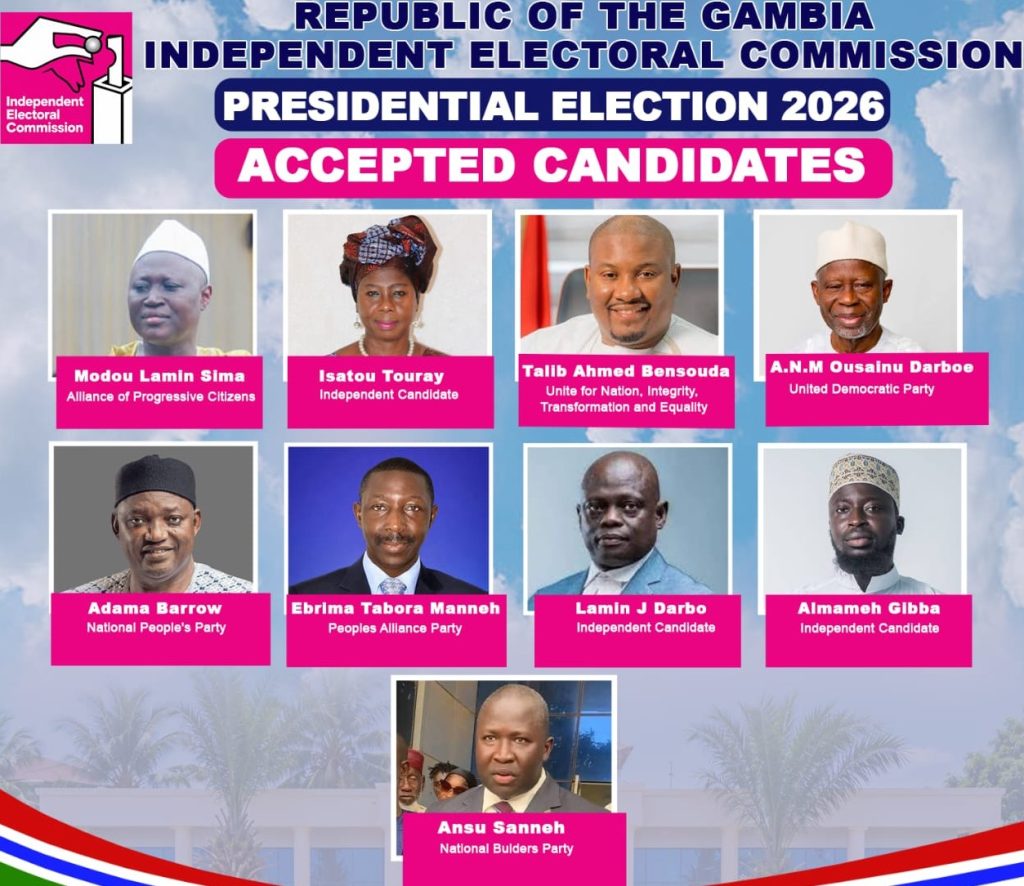
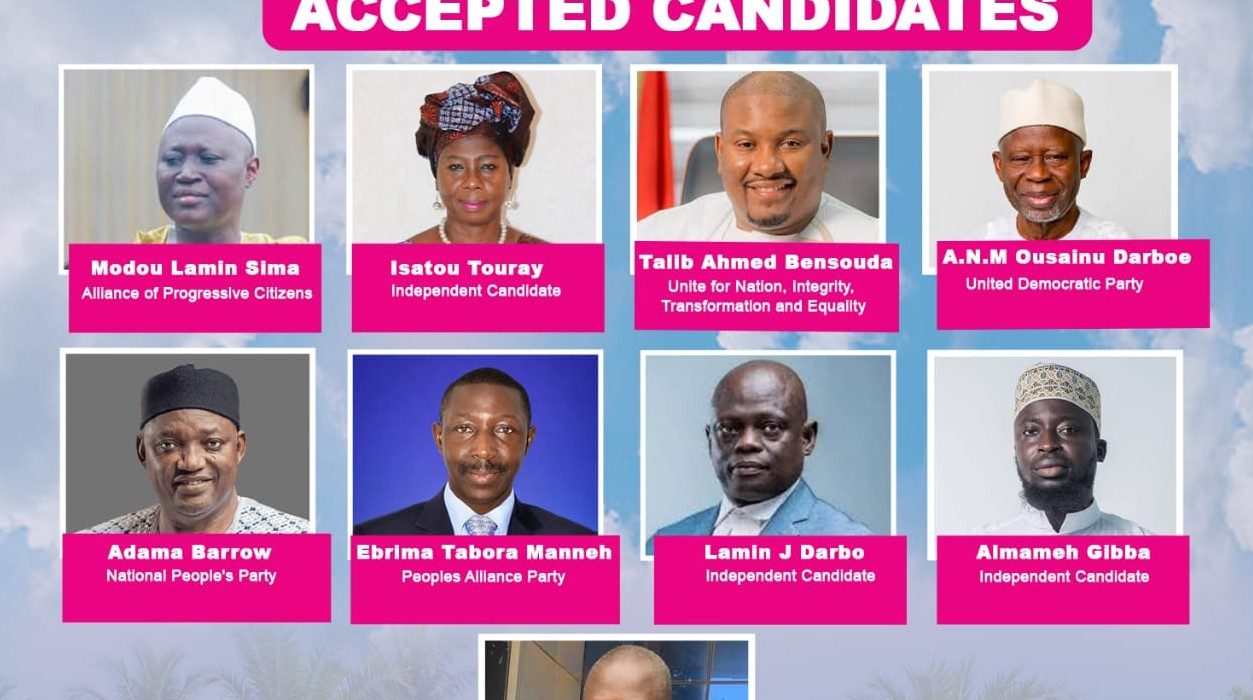
However, following the nomination process and the IEC’s assessment of candidates, only nine qualified to contest the December 5 presidential election.
They are incumbent President Adama Barrow of the National People’s Party (NPP); Ousainou ANM Darboe of the United Democratic Party (UDP); Talib Ahmed Bensouda of the Unite Party; Dr Isatou Touray, an independent candidate; Modou Lamin Sima of the Alliance of Progressive Citizens (APC); Ebrima Tabora Manneh of the People’s Alliance Party (PAP); Lamin J. Darbo, an independent candidate backed by the Team Gambia Grand Coalition; Almameh Gibba, an independent candidate; and Ansu Sanneh of the National Builders Party (NBP).
The 2026 presidential election is particularly noteworthy for the inclusion of Dr Isatou Touray, who is making history as the first woman to contest a presidential election in The Gambia.