



Bathurst’s Oldest Well Dug In 1820: The Well That Has Given Banjul Water for 200 Years
By Yunus S Saliu
Step into the garden of The Gambia National Museum in the heart of Banjul, and you may encounter an unlikely piece of the city’s history, a modest, centuries-old well that has quietly survived the transformation of Bathurst into modern-day Banjul.
It is not grand in appearance, nor does it immediately reveal the remarkable story behind it. Yet this historic well, believed to be the oldest surviving well in The Gambia’s capital, has continued to provide fresh water for almost two centuries.
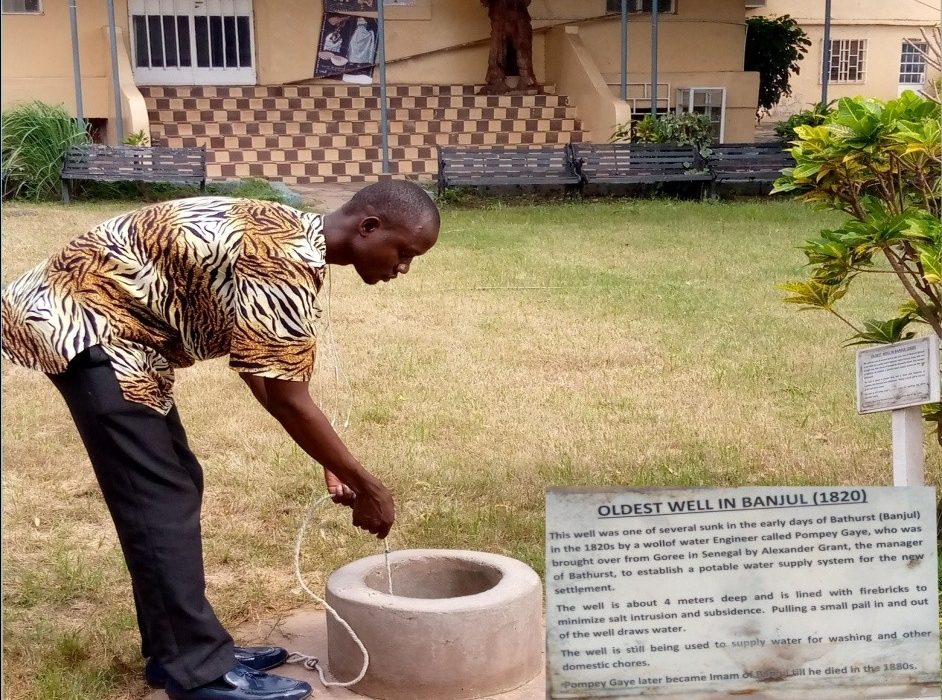
Situated within the grounds of the National Centre for Arts and Culture (NCAC), directly in front of the Gambia National Museum, the well is one of the few surviving physical reminders of the challenges faced by the early inhabitants of Bathurst and the ingenuity employed to provide the growing settlement with potable water.
For visitors interested in The Gambia’s colonial history, traditional engineering, culture and heritage, the well offers a fascinating glimpse into a period when access to fresh water was one of the most pressing challenges confronting the young settlement.
A Solution To Bathurst’s Water Problem
Bathurst was established by the British in 1816 on St Mary’s Island, now known as Banjul Island. Being situated at the mouth of the River Gambia and surrounded by the Atlantic Ocean, the settlement faced a fundamental problem: finding a reliable source of fresh water.
According to the historical signage beside the well, it was one of several wells sunk in Bathurst during the 1820s by a Wolof water engineer, Pompey Gaye.
Gaye was brought from Gorée, Senegal, by Alexander Grant, the manager of Bathurst, specifically to help establish a potable water supply system for the new settlement.
Historian and NCAC Director General Hassoum Ceesay explained that the early residents depended largely on water brought from surrounding areas, including Barra, under the authority of the King of Niumi, and Kombo, under the King of Kombo.
“Being an island, it became difficult to get fresh and pure water,” Ceesay explained.
He said the alternative sources were also unreliable because the authorities controlling access to them could restrict the supply.
“They can block the water supply as a punishment,” he noted.
The situation prompted the colonial administration to seek a more dependable solution within Bathurst itself.
Water engineers led by Pompey Gaye were therefore brought from Gorée to sink wells at different locations across the settlement.
The Well That Served Government House
Among the wells constructed at the time was the one now preserved at the National Museum.
According to Ceesay, this particular well had an important role in sustaining the colonial administration because it supplied fresh water to Government House and the army barracks.
“There were other four or five wells in other places in Bathurst at the time, but as of now, I think it is only this well here at the National Museum that is in good condition and still supplying fresh water when the tap goes off,” he said.
Remarkably, its usefulness has not ended with the colonial era.
Even today, people living around the museum continue to come to the well to collect water for domestic purposes, particularly when the city’s pipe-borne water supply is unavailable.
For a structure that dates back to the early decades of Bathurst, its continued functionality is extraordinary.
Engineering Beneath The Sands
Beyond its age, the well is also significant because of the traditional engineering techniques employed in its construction.
Ceesay explained that it was sunk into an artesian spring, providing access to a naturally occurring source of fresh water.
The walls were lined with firebricks to prevent the sandy soil from collapsing into the well and to protect the spring. The construction also helped minimise the intrusion of salt water, an important consideration given Banjul’s island location.
“Meaning it is very pure and technological drilling, and it is one of the highlights of the National Museum because when visitors come to visit the museum, they always check on it,” Ceesay affirmed.
Although the well is only about four metres deep, Ceesay said it has remained full of fresh water throughout its long history.
“For the past 200 years, it has never gone dry, and it is well protected,” he noted.
From Wells To Modern Water Supply
The story of the well is also the story of Banjul’s changing relationship with water.
For the early inhabitants of Bathurst, wells were essential to survival. Over time, however, the settlement moved towards more modern systems of water distribution, eventually developing the pipe-borne water network that became an increasingly important feature of the city from the 1930s.
The well therefore represents more than an old source of drinking water. It provides a physical connection between two eras, the early colonial settlement that depended on hand-sunk wells and the modern city supplied through an expanding water infrastructure.
“It is really an important relic of the colonial history of Bathurst town, now Banjul City, to show the transition from wells to pipe-borne water in the 1930s and up to the present day,” Ceesay said.
The Man Behind The Well
Adding another fascinating chapter to the story is the life of Pompey Gaye, the engineer credited with sinking the well.
After helping address Bathurst’s water crisis, Gaye later became an imam in Banjul, a position he held until he died in the 1880s.
His legacy therefore extends beyond engineering. His work became part of the physical foundation of a city whose population, institutions and infrastructure would continue to grow long after his death.
A Heritage Attraction Waiting To Be Noticed
Today, the well stands quietly in the garden of the National Museum, easily overlooked by visitors focused on the museum’s collections and exhibitions.
But for those willing to pause and look closer, it tells a story that reaches back to the earliest days of modern Banjul.
Its bricks, its depth, its water, and its remarkable survival all speak to a different era, when a reliable source of fresh water could determine the survival and development of an entire settlement.
For tourists and heritage enthusiasts exploring Banjul, the well offers an intimate encounter with the city’s past. It is a reminder that heritage is not always found in imposing monuments or elaborate buildings. Sometimes, it is found in something as simple as a well that has continued to serve generations of people.
Nearly two centuries after Pompey Gaye sank it into the sands of Bathurst, the well remains, quiet, functional, and remarkably alive, linking present-day Banjul with the city that once stood at the beginning of its journey.