




Fanal: Traditional Lantern, First Built In The 1860s
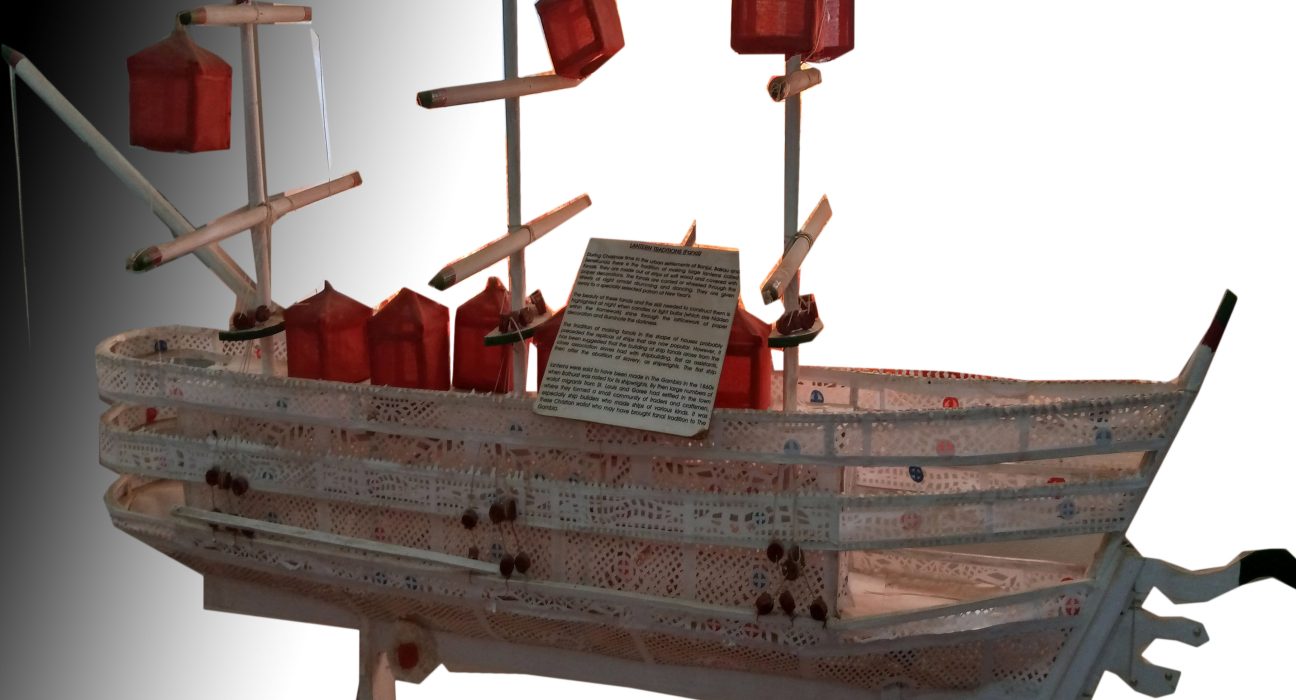
Fanal: The Gambia’s Traditional Christmas Lantern Dating Back To 1860s
By Yunus S Saliu
As the Yuletide season approaches, people often take time to reflect on traditions of the past and compare them with the customs of today as they prepare to welcome a new year.
One such enduring tradition is the “fanal,” a large, elaborately decorated traditional lantern that was once a prominent feature of Christmas celebrations in urban settlements across The Gambia, particularly Banjul, Bakau and Serrekunda.
Fanals were traditionally constructed from strips of softwood and covered and decorated with paper. During the Christmas season, they were carried or wheeled through the streets at night, accompanied by drumming, singing and dancing. At the end of the celebrations, the fanals were sometimes presented to specially selected patrons as part of the New Year festivities.
The beauty of the fanals, as well as the craftsmanship required to construct them, was particularly evident at night. Candles or, in later years, light bulbs placed inside the wooden framework illuminated the lanterns from within, allowing light to shine through the intricate latticework and colourful paper decorations.
Origins of the Fanal
Historical accounts suggest that the first ship-shaped lanterns in The Gambia were made in the 1860s, when Bathurst—present-day Banjul—was known for its skilled shipwrights.
At the time, large numbers of Wolof migrants from Saint-Louis and Gorée had settled in Bathurst, forming a small but active community of traders and craftsmen. Among them were skilled shipbuilders who constructed different types of vessels.
Bathurst and the surrounding settlements were home to a diverse population comprising Europeans, free Africans, people of mixed European and African ancestry, and enslaved Africans. Among the prominent residents were wealthy Christian women of mixed ancestry, commonly known as Signares, whose wealth was often associated with property and slave ownership.
Historical accounts suggest that these women became some of the earliest patrons of lantern makers.
According to oral tradition, the origins of the fanal can be traced to the Christmas practice of enslaved people accompanying their Signares to midnight Mass while carrying candles.
Because the candles were exposed to the strong coastal winds, they could easily be extinguished. To protect the flames, simple shelters were devised around the candles. Over time, these protective structures became more elaborate and were transformed into miniature representations of the grand houses occupied by the Signares.
The tradition later developed into a broader Christmas celebration. Following the midnight service, one of the Signares would host a Christmas gathering attended by other members of the community.
While the celebration was taking place, enslaved people would move from house to house carrying their lanterns, stopping at different homes to receive gifts, including money and other items.
From Houses to Ships
The traditional practice of constructing fanals in the shape of houses is believed to have preceded the development of the ship-shaped fanals that later became particularly popular in The Gambia.
The emergence of ship-shaped fanals is closely associated with Bathurst’s strong maritime and shipbuilding tradition.
Many of the craftsmen involved in constructing the lanterns had connections to the shipbuilding industry, initially working as assistants and later becoming skilled shipwrights following the abolition of slavery.
Their knowledge of ship construction eventually influenced the design of the fanals, transforming them from simple illuminated structures into elaborate replicas of ships.
Over generations, the fanal became more than just a Christmas decoration. It evolved into a distinctive cultural expression combining craftsmanship, music, dance, community participation, and religious celebration.
Although the tradition has declined significantly in some urban areas, the fanal remains an important part of The Gambia’s cultural heritage and a reminder of the country’s complex history, particularly its links with Christianity, maritime life, migration, craftsmanship and colonial-era urban society.
As Christmas is celebrated once again, the story of the fanal offers an opportunity to reflect on a tradition that has illuminated Gambian streets for generations and remains an important part of the country’s rich cultural heritage.