



NCAC Publishes The Gambia Intangible Cultural Heritage Inventory Catalogue
By Yunus S Saliu
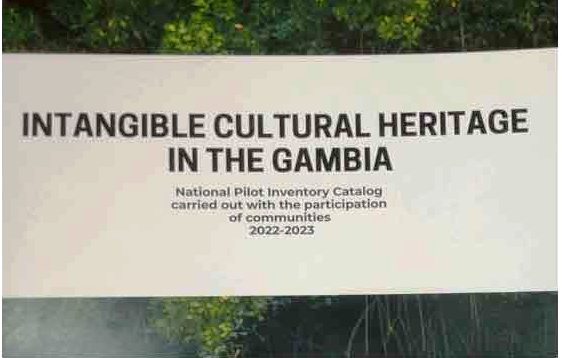
The National Centre for Arts and Culture (NCAC) has published The Gambia’s Intangible Cultural Heritage (ICH) Inventory Catalogue as part of the country’s commitment to safeguarding its rich living cultural heritage.
The catalogue was presented to the public on Wednesday, December 20, 2023, at the National Museum in Banjul, following The Gambia’s ratification of the UNESCO 2003 Convention for the Safeguarding of the Intangible Cultural Heritage.
The presentation of the national pilot inventory catalogue brought together representatives from various communities and stakeholders involved in the preservation and promotion of The Gambia’s cultural heritage.
The initiative forms part of a project on “Strengthening National Capacities for Safeguarding Intangible Cultural Heritage and Contributing to Sustainable Development in The Gambia.” The project was developed under the UNESCO 2003 Convention, with implementation commencing in 2022.
It was implemented within the framework of the Culture Programme of the UNESCO Regional Office in Dakar, in collaboration with the NCAC under the Ministry of Tourism and Culture.
Speaking on the process, Hassoum Ceesay, Director General of the NCAC, explained that the capacity-building component of the project involved a series of training sessions and technical guidance provided by two international ICH facilitators.
He said the programme began with an introductory meeting for relevant stakeholders to discuss the general objectives and obligations involved in safeguarding intangible cultural heritage, followed by training workshops for government officials, technical staff and prospective national trainers.
“We conducted community-based inventorying to deepen the national ICH facilitators’ understanding of the concept of safeguarding, associated ethical principles, and enhance their skills in developing realistic ICH safeguarding plans,” he said.
According to DG Ceesay, the knowledge and skills acquired through the training provided a foundation for selected trainees to conduct community-based inventorying of ICH elements across six regions of The Gambia.
The practical exercise resulted in the documentation of several cultural practices, traditions, knowledge systems and skills representing the country’s diverse intangible cultural heritage.
Documenting Gambia’s Living Heritage
In the Greater Banjul Area, the inventorying exercise documented several elements, including the Hunting Devil, Traditional Wedding Ceremony, Baby Wrapper, Traditional Gardening Techniques and Oyster Harvesting.
In the West Coast Region, documented elements included the Community Tribunal, Kayegak/Ja Nyurak (traditional wrestling), Kumpo cultural practice and Butusob (traditional dance).
The North Bank Region recorded a range of practices, including the playing of the Tabulo, Bamba Malayandoo (the sacred crocodile pool), Koo Bondoo (salt mining), Sutoo Kankurang Aadoo (night Kankurang), Tibadaa and Tibang Singo (traditional thatching), as well as Kayaa, Kojewo, Dolingo and Bamoo, which are traditional fishing techniques.
In the Lower River Region, the inventory included Foday Kabba Dumbuya La Tariko, the story of Foday Kaba Dumbuya; Nyansing Denkiloo; Barawuloo, Jiidaano and Korondo, which are associated with rain rituals; Moofing Jaaraloo (traditional healing); and Danayaa and Fayrlaa (traditional hunting).
The Central River Region was represented by cultural elements including Lip and Gum Tattooing, Tabaah Ndaal (pottery), Munkutuwo (rice paste-cake festival), Bang Doikuwo (bamboo stitching) and Ndewtungu (Fula traditional wedding ceremony).
In the Upper River Region, the inventory documented Wurundoo (weaving), Teng Dolo Soo, Kawa Wak, Jam Sengar and Chokgol Konjam, the Nyejeh (palm wine tapping), as well as Wulakono Dutoo (wild mango).
The publication of the inventory catalogue marks an important step in documenting and promoting The Gambia’s living heritage. It also provides a foundation for further research, community participation and the development of safeguarding measures aimed at ensuring that traditional knowledge, practices and cultural expressions are preserved for future generations.
The NCAC, through its collaboration with UNESCO and communities across the country, continues to strengthen national capacity for the identification, documentation, safeguarding and promotion of intangible cultural heritage in line with the objectives of the 2003 UNESCO Convention.