

Kukoi Coup: 45 Years After The Gambia’s Eight-Day Ordeal
By Yunus Saliu
By Yunus S Saliu
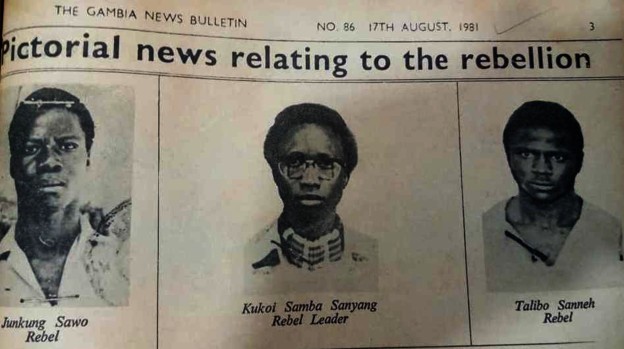
Forty-five years ago, The Gambia experienced one of the most devastating political crises in its post-independence history: the Kukoi Coup of July 1981, an eight-day rebellion that left about 1,000 people dead and caused widespread destruction, looting and arson.
The attempted coup, which targeted the government of President Alhaji Sir Dawda Kairaba Jawara and the ruling People’s Progressive Party (PPP), has been described by historian Hassoum Ceesay as unique because it was led largely by civilians rather than members of the armed forces.
Narrating the events in an interview with this reporter, Ceesay said the country was rocked by the coup attempt while President Jawara was in London attending the wedding of Prince Charles and Lady Diana Spencer.
“The violence lasted eight days, and 1,000 Gambians were killed, while properties worth US$5 million were lost to looting and arson,” he explained.
According to Ceesay, the coup was unusual because its principal actors were largely civilians, including taxi drivers, fishermen, watchmen and others.
“While President Jawara was away in London, UK, attending the marriage ceremony of Princess Diana and Prince Charles, Kukoi, assisted by 11 men, walked from their base in Tallinding to Bakau, where they attacked the Field Force Armoury and started the coup on 30 July 1981, a day before Tobaski,” he said.
Ceesay recalled that the first person killed during the attack was Kikala Baldeh, the Armoury Commander. The rebels subsequently seized Radio Gambia, Yundum Airport and State House.
At Radio Gambia, Kukoi made his first broadcast announcing the coup and declared the formation of a new government, the Supreme Council of the Revolution (SCR), which he chaired.
At State House, the rebels took First Lady Augusta Jawara and members of the Jawara family hostage. They were eventually freed following the intervention of a special British force.
The historian described the widespread hostage-taking as one of the most disturbing features of the coup, noting that it was largely unknown in previous coup attempts on the African continent.
But hostage-taking was not the only tactic employed by the rebels.
According to Ceesay, Kukoi also ordered the abduction of prominent Gambians and forced some of them, at gunpoint, to denounce President Jawara over Radio Gambia.
“Sanjally Bojang, the respected chief and farmer, was a good example. They were forced to denounce Jawara and to ask him not to return to The Gambia,” he said.
Growing Tension Before the Coup
Looking back at the period preceding the coup, Ceesay said signs of political instability had become increasingly visible.
“The writings were literally and figuratively on the walls. There was a looming disaster, and all Gambians knew something terrible would befall our Republic,” he said.
He recalled that between 1979 and 1981, a youth revolt had emerged, driven by various anti-government underground groups, including the Black Scorpions, the Movement of Justice in Africa (MOJA) and the Gambia Socialist Revolutionary Party led by Pengu George.
“These groups organised youths into a resistance mood, and there was arson, such as the burning of President Jawara’s yacht, the MV Mansa Kila Kuta; the burning of markets, street graffiti, and sustained insults against state leaders, including Jawara, and denigration of state institutions like The Gambia Commercial and Development Bank,” Ceesay explained.
He also recalled the assassination of Field Force Commander Eku Mahoney at Bakau Barracks by a sentry, Mustapha Danso, saying the incident in November further shocked the country.
“By the time Kukoi struck, the PPP government was under sustained attack and severely undermined,” he said.
“Kukoi’s coup was the coup de grâce; a lot of damage had been inflicted on the state already,” Ceesay added.
Who Was Kukoi Samba Sanyang?
Asked about Kukoi Samba Sanyang, Ceesay described him as a brilliant young man whose political journey eventually took him into revolutionary politics.
“He was a brilliant young man. Born in 1953, and died in 2013. He finished St Augustine’s High School in Banjul and entered the famous Ngasobil Seminary in Senegal to train to become a Catholic priest,” Ceesay said.
According to him, Kukoi was later expelled from the seminary and entered politics.
“In 1977, he stood as an NCP candidate in the elections of that year. Kukoi had faith in the democratic process of our Republic; he lost the elections in the Foni East Constituency that year, getting less than 800 votes, and became disillusioned,” he explained.
Between 1977 and July 1981, Kukoi travelled extensively and became exposed to revolutionary ideas. Ceesay said he lived in Libya and became known to the country’s then leader, Colonel Muammar Gaddafi, who was suspected of providing support for the attempt to overthrow the PPP government.
“Kukoi was a brilliant man who became a miserable revolutionary,” Ceesay said.
Senegalese Intervention
The coup was eventually crushed following Senegal’s military intervention.
Ceesay explained that when President Jawara learned of the coup, he was advised by loyal ministers, who were then sheltering at Police Headquarters in Banjul, that resistance by loyal security forces could help stop the rebellion.
Jawara subsequently invoked the 1965 Defence Pact between The Gambia and Senegal and instructed The Gambia’s High Commissioner in Dakar to seek military assistance from Senegal.
“Senegal sent troops to Banjul on 1 August 1981, and they crushed the rebels, while Kukoi fled to Bissau,” Ceesay said.
He noted that dozens of Senegalese soldiers died during the fighting, including 18 soldiers who were killed when a military helicopter was shot down by Kukoi’s forces near Radio Syd.
“Senegal sacrificed to restore democratic order in The Gambia,” he said.
Jawara’s Post-Coup Response
Ceesay said former President Jawara handled the aftermath of the coup without resorting to widespread revenge or collective punishment.
“He refused to be vindictive or vengeful. No ethnic group or region was profiled for the coup,” he said.
According to the historian, more than 2,000 people were detained, but the authorities accounted for those arrested, with arrest warrants issued and names gazetted.
“There was no impunity. The hybrid courts tried the accused, and many, including opposition leader S.M. Dibba, were freed; others were sentenced. No executions took place from the treason trials. Rule of law was maintained,” Ceesay explained.
He added that all 3,000 rifles taken from the Bakau depot during the coup were recovered by the end of August 1981.
Ceesay also highlighted Jawara’s decision to resume his traditional Meet the Farmers Tour from August 12 to 20, 1981, despite the recent upheaval.
According to him, the tour was used to explain the events to Gambians and promote national unity and reconciliation.
“State institutions like the Civil Service and Judiciary were soon back at work,” he said.
Media and National Reconciliation
Ceesay said the media, particularly Radio Gambia, played an important role in helping the country recover from the crisis.
“Through Radio Gambia flagship programmes like One Gambia, One Nation, Gambians quickly reconciled and started the recovery process,” he said.
He also cited the work of the Looted Properties Commission, headed by Alhaji K. Conteh, which helped recover more than 70 per cent of goods looted during the uprising.
Similarly, the Detainees Review Panel, led by Sheikh Joof, reviewed arrests made during the crisis and facilitated the release of people who had been wrongfully detained.
“Through the External Aid Commission led by Ambassador E.M. Taal, international support poured into the country, and ordinary Gambians also contributed money, chickens and cows to the government’s recovery effort,” Ceesay revealed.
He noted that Japan was among the countries that provided substantial assistance.
“Japan, for example, donated so many vehicles that Government started allocating cars to Civil Servants, a practice which exists today,” he said.
Lessons for Today
Reflecting on the lessons The Gambia can draw from the events of July 1981, Ceesay warned against the erosion of public confidence in democratic institutions and elected leaders.
“Well, there was too much bile and bitterness and insults against our elected leaders and public institutions in the years leading to the July 30, 1981 catastrophe. Public confidence was severely eroded. There was angst,” he said.
He recalled that the opposition NCP had launched its “sosolaso” campaign, promising to challenge the PPP government aggressively, creating an increasingly hostile political atmosphere.
“Kukoi used this opportune moment to strike. So Gambians should be reminded of this,” Ceesay cautioned.
Forty-five years after the Kukoi Coup, the events of July 1981 remain a significant chapter in The Gambia’s political history — a reminder of the dangers of political polarisation, the importance of protecting democratic institutions, and the need for national reconciliation in times of crisis.