



Nyankusita: A Sacred Baobab Tree In Janjangbureh
By Yunus S Saliu
Among the many cultural and heritage sites scattered across Destination Gambia, few carry the mystery, tradition, and historical significance associated with the Nyankusita Sacred Baobab Tree on the historic island of Janjangbureh in the Central River Region (CRR).
Believed to be more than 200 years old, the majestic baobab is deeply connected to the cultural history of Janjangbureh and remains an important site for understanding traditional initiation practices of earlier generations.
Known locally as a sacred tree, Nyankusita is particularly remembered for its association with the initiation and circumcision of young boys.
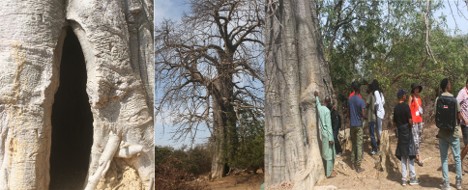
The tree itself is striking. Its massive trunk has an opening resembling a doorway, providing access to an inner chamber that is remarkably cool despite the heat outside. From the exterior, the ancient baobab continues to appear fresh and healthy, standing as a living reminder of generations of cultural traditions.
According to the history of Nyankusita, as narrated by Musa Foon, a museum attendant of the National Centre for Arts and Culture (NCAC) attached to the Kankurang Museum Centre in Janjangbureh, the sacred tree once served as a central gathering point for elders preparing for the annual initiation of boys.
Foon, who also works as a tour guide, explained that when the time came for initiation, elders would gather beneath the Nyankusita tree to discuss and organise the ceremony.
The Red-Clad Messenger
In the old days, there was no formal public announcement system for summoning elders to such a meeting. Instead, a distinctive traditional method was used.
According to Foon, an elderly man would dress entirely in red, including his clothes, shoes and cap, and walk around the community. “There was no formal system of making announcements, but the only means recognised was that an older man would dress in all red — red shoes, clothes and cap — to walk around the community,” Foon explained.
“Immediately, elders in the community saw him; they knew straight away that there was a community meeting, an emergency one for that matter, scheduled for that day at 5 pm under the Nyankusita tree.” The gathering beneath the ancient baobab was not an ordinary community meeting.
It was where elders would discuss the date of the initiation, the cultural activities to accompany the ceremony, and the type of Kankurang that would be permitted to appear and protect the children during the initiation.
The Kankurang, an important masquerade tradition associated with Manding communities and recognised for its cultural significance, has long been linked to initiation rites and community protection.
A Sacred Space Reserved for Elders
The sacred nature of Nyankusita also meant that access to the area was traditionally restricted during important meetings. Foon explained that women were not permitted to attend these particular gatherings under the tree.
Even boys who had not undergone circumcision, as well as males below the age of 20, were traditionally forbidden from coming near the tree during such meetings unless they were among those being prepared for initiation. The restrictions reinforced the special status of Nyankusita as a sacred space and ensured that matters concerning initiation remained within the circle of those traditionally authorised to participate.
Inside the Sacred Baobab
The most intriguing part of Nyankusita’s history concerns what tradition says happened during the actual initiation ceremony.
According to Foon, when the day of initiation arrived, the boys would gather at the site and form a queue, with their fathers standing behind them. One by one, the children would enter the baobab through its narrow opening, which would be covered with cotton. The child would enter the inner chamber alone while his father waited outside.
What happened inside was traditionally known only to those involved in the sacred process. Foon said that those waiting outside would sometimes suddenly hear the cry of a child coming from within the tree.
“When such a child comes outside from the tree, he will be found circumcised, without anybody who can tell or have any idea of how or who circumcised him inside the Nyankusita tree,” he said. For generations, this mysterious account has formed part of the oral history surrounding the sacred baobab.
Foon described the practice as being associated with supernatural powers, saying that traditionally no one could explain how the circumcision took place inside the tree. “This is real, and it is done out of some supernatural powers because no one knows or can tell how any child that enters inside Nyankusita is being circumcised or what circumcises them when they are inside it,” he emphasised.
The Baobab As A Source Of Healing
The tradition did not end when the child emerged from the tree. According to Foon, the boy’s father would provide him with clothing to wear after the ceremony. Leaves from the Nyankusita tree would then be collected, chewed, and the resulting liquid spat onto the wound as part of the traditional healing practice. “This will be done to all of them,” Foon explained.
Whether viewed through the lens of traditional belief, oral history or cultural anthropology, the story surrounding Nyankusita provides a fascinating insight into the practices, beliefs and social structures that shaped community life in earlier generations.
A Living Heritage
Today, Nyankusita stands quietly on Janjangbureh Island, but its enormous trunk carries memories of a very different time. It represents more than an old tree. It is a cultural landmark connected to initiation, community authority, traditional healing, the Kankurang, and the spiritual beliefs of generations of people who lived on the island.
For visitors exploring Janjangbureh, the Nyankusita Sacred Baobab offers an opportunity to look beyond conventional tourism and encounter a part of The Gambia’s living heritage. Its significance lies not only in its age or physical appearance, but in the stories passed down around it — stories that connect today’s generation with the traditions of those who came before.
As The Gambia continues to promote cultural and heritage tourism, sites such as Nyankusita demonstrate the richness of the country’s intangible heritage. The ancient baobab remains rooted in the soil of Janjangbureh, silently standing as a witness to centuries of community life, traditional ceremonies, and stories that continue to intrigue visitors.
And perhaps that is the greatest attraction of Nyankusita: the tree does not simply tell a story of the past; it keeps the memory of that past alive.